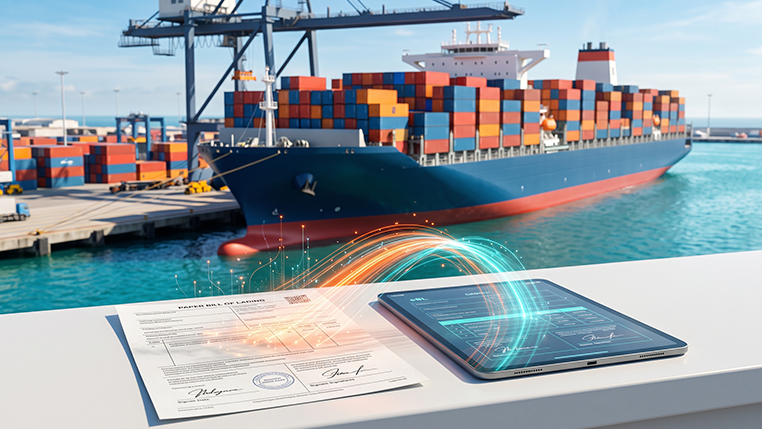
In 2026, a container ship’s route can be reassessed by digital systems using weather and port data. Yet the quotation for the cargo it will carry may still be sitting in the third tab of an Excel workbook, based on a rate sheet last updated two weeks ago. Operations are becoming digital while the commercial side falls behind.
For a long time, this gap was treated as an ordinary industry problem. Today, slow quotations, outdated rates and repeated data entry have a direct commercial cost. This article examines what AI can and cannot solve in freight quotations and pricing, and where freight forwarders should begin.
Key takeaways
- While a spot quotation waits for days, BAF, GRI and peak-season surcharges may change. A late quotation either loses the job to a competitor or commits the forwarder to a loss-making shipment.
- AI-assisted pricing tools can combine historical lane data, market rates and target margins into a single recommendation. That recommendation is not a binding carrier quotation or a confirmed booking.
- For exceptions such as out-of-gauge cargo, AI does not make the decision; it shows earlier where a decision is needed.
- In rate forecasting, the main obstacle is often not the algorithm but fragmented, inconsistent historical data. The order should be data first, integration second and the model last.
- In an Ontegos Cloud survey cited by Freightos, 77% of forwarders said they lacked data of the quality AI requires.
- Road freight research reports that 65–80% of the contracted lanes studied became unused “ghost lanes”.
The current picture: quotations wait for days while rates change
Slow quotation responses are a documented industry problem. In a 2015 Freightos study of online LCL quote requests sent to 16 major forwarders, the average time to receive a quote was 90 hours, almost four days. This is an older, small-sample finding, not a current industry-wide benchmark. In that time, bunker adjustment factors (BAF), general rate increases (GRI) and peak-season surcharges may change.
When a quotation prepared on Thursday morning reaches the customer on Monday, there are two possibilities: the price is now above the market and the job has gone to a competitor, or rising costs were not accounted for and the forwarder has committed to a loss-making shipment. Both are losses; the only difference is when you find out which one happened.
The human cost matters too. A pricing specialist should be making margin and risk decisions, yet much of the day may go on moving data from rate sheets to emails and from emails into systems. A Freightos article cites an Ontegos Cloud survey reporting that 77% of forwarders lacked data of the quality AI requires, and that manual entry and corrections took up to 70% of their time. Ontegos, a software vendor, surveyed around 800 freight forwarding and logistics professionals in August and September 2025, so these figures are best read as indicative rather than as an industry benchmark.
What can AI-assisted pricing solve, and where are its limits?
AI-assisted pricing helps quotation teams work faster by bringing scattered data into one recommendation, but leaves decisions on non-standard cargo to people. In principle, the promise is simple: historical freight rates, current market benchmarks and capacity information are assessed together to produce a faster price recommendation.
Real products are being built around this promise. In June 2026, Transfix, a US provider of transport management software for freight brokers, announced an AI rate recommendation tool for road freight brokers. It combines five data sources that brokers previously checked in separate panels (market rate, lane history, cost-model forecast, projected margin and award history) into a single recommendation inside the quoting form.
It is still necessary to check whether an automated recommendation reflects a current, binding carrier quotation. A price recommendation does not mean a booking has been confirmed. The limits appear as soon as a shipment falls outside the standard pattern.
Consider an out-of-gauge shipment: a transformer that will not fit on a standard flat rack. Its price involves far more than freight alone: a special crane booking, lashing and securing calculations, terminal handling costs that may be higher than for a standard container, restrictions at transhipment ports and, on top of all this, the risk of demurrage if the documents do not match the cargo. A pricing engine may flag some of these variables and warn, “This cargo is non-standard: take care.” But the work beyond that warning, such as negotiating a crane slot with the port agent, confirming the securing plan with a surveyor and, if necessary, designing an alternative multimodal route, still requires human expertise. AI is not making the decision here; it shows earlier where a decision is needed. That is useful, but it is not end-to-end automation.
From email chains to structured quotations
The shift in tendering is quieter but more structural. Alongside request-for-proposal (RFP) email chains with twenty people copied in, structured bid formats with defined fields, traceable versions and comparable responses are becoming more common. This is not a cosmetic change: a structured quotation can be analysed after the fact. You can only learn which price lost you a particular lane if your data is stored in a searchable format.
Carrier connections and structured bid data can reduce the need to search through individual emails for capacity and rate information. One example is the collaboration announced by Crane Worldwide Logistics and cargo.one on 17 March 2026: Crane aims to bring procurement and quotation rate data into shared infrastructure to support its operations in 33 countries. The announcement describes an implementation plan; it does not mean the rollout has been completed in every country or that live booking is available across every transport mode.
Why does data quality determine freight rate forecasting?
Because a model can only make recommendations as reliable as the historical data it receives. The rate forecasting work of Freight Right founder Robert Khachatryan and Vishal Gupta of the USC Marshall School of Business shows the problem. Khachatryan pointed out that the industry’s own data often undermines a model from the start; as one example, he cited around 27 different ways people refer to freight. Gupta warned that the 97–99% accuracy AI reaches in image recognition is not a realistic expectation for freight rate prediction (Freightos article). This does not show that AI has failed in general; it shows that rate forecasting may not be reliable without a clearly defined problem and clean data.
Gupta also advises against mixing up two different “rate prediction” problems: helping forwarders prepare quotations faster on recurring lanes, and helping cargo owners plan tenders, budgets and contract-versus-spot decisions under uncertainty.
The data problem is even more visible in less-than-container-load (LCL) shipments. LCL pricing depends on consolidation dynamics: the volume of other cargo in the same container, occupancy at the origin warehouse and agreements with co-loaders can all affect the result. If those variables are recorded inconsistently, it becomes hard to draw reliable comparisons from historical data.
The lesson is that AI can make meaningful freight pricing recommendations only when it is fed clean, comparable data, and its forecasts should be treated as inputs to pricing and risk decisions, not as predictions to follow blindly. Data cleaning is an unglamorous starting point, but it often matters more than the choice of model.
How should spot and contract freight rates be balanced? Ghost lanes
There is no single ideal ratio; it depends on the lane, customer, season and capacity conditions. Contract rates can be valuable for regular, predictable volumes, while spot options may suit irregular volumes and unexpected requirements better.
Another problem arises when a lane is priced during a tender but no freight moves on it during the contract period. Known as a “ghost lane”, this wastes bidding effort and can undermine confidence in volume forecasts for later tenders. Research by C.H. Robinson and MIT on road freight reports that 65–80% of the contracted lanes examined became ghost lanes. This finding cannot be generalised to ocean or air freight.
The cost of ghost lanes is not limited to an unused rate line. According to a research summary published by C.H. Robinson, every ten-percentage-point increase in the share of lanes awarded to a provider but not used was associated with an increase of about 1% in that provider’s contract rates the following year. This is an association under specific research conditions, not a guaranteed price increase for every carrier. In other words, the cost of ghost lanes may show up in contract prices a year later.
AI-assisted tools can support these decisions, but it should not be assumed that every spot request can be priced automatically. The value a forwarder adds lies in managing this distinction: using data to decide which traffic belongs under a contract and which is better served by the spot market.
Is AI a threat to freight forwarders, or a lever for growth?
I do not agree that automated pricing will make freight forwarders obsolete, and I think that conclusion follows from the structure of the business model, not from wishful thinking.
The part of pricing most suited to automation is where forwarders already add the least value: repetitive quotations for standard cargo on standard lanes. Margins in that work may be narrowing, and AI can speed the process up. But the real margin has always been in the exceptions: complex cargo, disrupted routes, discrepancies between documents and physical goods, and problems solved through personal relationships during a crisis.
Jan Harnisch, CEO Air & Ocean at Rhenus Group, describes this shift: the forwarder of the future will spend less time processing shipments and more time managing exceptions, and as AI takes on much of the routine flow, operators will move into a logistics “command centre” role. Harnisch adds an important qualification: when things get complicated, people should not just be in the loop but lead the process and take full control (The Loadstar).
In practice, AI detects anomalies: it flags shipments that deviate from the expected pattern and leaves the rest to people. Repairing a broken supply chain through trusted relationships, securing capacity from a carrier on the strength of years of cooperation, or designing an alternative route within hours during a geopolitical crisis: none of these can simply be taken from an automated system.
The less-discussed aspect is scale. Harnisch also acknowledges that AI lowers barriers to entry and lets smaller teams build sophisticated systems. This could allow mid-sized forwarders to handle work that once required large pricing teams with fewer people; however, that is an interpretation, not a measured outcome.
The next three to five years: following air freight, but more slowly
I expect ocean freight to go through a digital transformation similar to the one air freight has gone through recently, with wider use of dynamic pricing and API-based booking. However, differences in contract structures, data access and integration with legacy systems mean I do not expect every company to move at the same pace. This is a forecast, not a fixed timetable.
The most persistent barrier is often not technology but the comfort of staying with legacy systems and the failure to keep data under common definitions. Using AI is also not the same as creating measurable value across an organisation. In McKinsey’s 2025 survey, 88% of respondents said their organisations regularly used AI in at least one business function, while about 6% met the study’s definition of “AI high performers”. These figures are not specific to logistics. In other words, use is widespread, but those creating measurable value remain a minority.
That gives companies a clear order of priorities. First, data: standardise historical rate records, harmonise lane and surcharge definitions, and make quotation history searchable. Next, integration: set up suitable carrier connections and move towards structured bidding. Only then the model: a pricing engine makes sense once there is clean data to feed it. Projects that reverse this order risk running into the same data-quality problems seen in the Freight Right example.
In the short term, companies that answer spot requests faster and more consistently, while spending less effort on bids for unused lanes, may gain an advantage. Over the longer term, the dividing line may be more fundamental: not who has the best algorithm, but who can feed it clean, accurate data through suitable integrations. For those who stay with Excel tabs and email chains, the risk is less a sudden collapse than a quiet, hard-to-reverse loss of market share.
Freight quotation workflows with Modaltrans
Speed matters in freight quotations, but so does being able to track rate and cost data within the same workflow. Modaltrans is logistics software built for freight forwarders and logistics service providers. In its Advanced CRM module, you can prepare multi-option quotations using predefined tariffs, turn accepted quotations into bookings, and analyse won and lost quotations. That way, the question of which price lost you which lane is answered from a searchable quotation history. Before moving towards AI-assisted pricing, the first step is to keep rate and quotation data consistent and searchable.
To follow shipments from quotation through to delivery, see the Freight Management page, or request a demo to see how you can manage quotations and bookings. To compare ocean freight rate tools, read our comparison of ocean rate management services. If you want to know where published tariffs fit in air freight quotations, our guide to IATA TACT rates explains it.