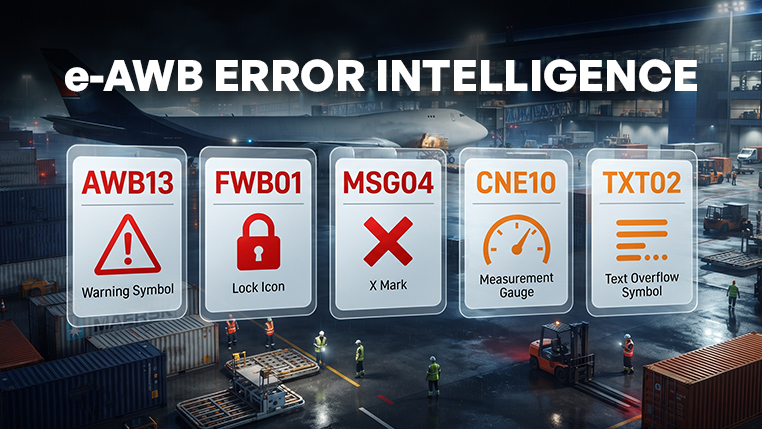
When an e-AWB message gets rejected, you lose hours while cargo sits at the terminal. This guide lists IATA's full FWB error code set with plain-English explanations, and flags the five critical errors that actually stop an operation.
When an e-AWB message gets rejected by the airline's system, you lose hours — cargo sits at the terminal, the customer calls, and nobody knows why. But the issue usually comes down to a single field: a missing postal code, a contact string over 69 characters, or a routing that doesn't match the booking. IATA's MIP Strategy v4 standard, with its simplified error code set (short format XXX99), lets you diagnose these issues in seconds — as long as you know what the code means.
What Is an FWB Error Code?
FWB (Freight Waybill) is the electronic air waybill message sent to the carrier's system as part of the e-AWB process. If this message is rejected or cannot be processed, the system returns a short error code made up of a three-letter category and a two-digit number (for example, AWB13, CNE10, FWB01). Every code falls into one of three error types:
D — Data error: A specific field contains invalid or missing data.
R — Rejected: The message was rejected outright for the stated reason.
S — Syntax error: The message format itself is invalid, so the system can't process it at all.
Note: all error codes below apply specifically to FWB messages.
The 5 Critical Errors to Check First
Of the 150+ codes, only a handful actually bring an operation to a halt — most are field-level warnings. These are the ones that mean outright rejection:
AWB13/AWB14 — AWB serial number issues. AWB13 means the serial number is blacklisted; AWB14 means it hasn't been allocated to the forwarder at all. Both reject the message outright — this is the first place to check.
FWB01/FWB02 — Booking mismatch. FWB01 means the FWB data differs significantly from the booking; FWB02 means the routing differs from the shipment booking. This usually stems from last-minute changes made after booking.
MSG04-MSG07 — System-level rejection. These aren't field errors, they're communication issues: the data was already created in the carrier's system (MSG04), the sender's TTY address isn't recognized (MSG05) or isn't configured for this message type (MSG06), or the message version isn't supported (MSG07).
CNE10 / NFY09 / SHP10 — the 69-character limit. For the consignee, notify, and shipper blocks, the combined total of country code, postal code, contact ID, and contact number can't exceed 69 characters. Long addresses or phone numbers hit this limit easily.
TXT02 — the 545-character limit. If the free-text description of goods exceeds this length, the message is rejected for a syntax error — a common trap for teams entering detailed product descriptions.
Accounting Information Errors (ACC)
Code
Type
Description
ACC00
Data error
Invalid or missing accounting information details
ACC01
Data error
Accounting information identifier
ACC02
Data error
Accounting information
Agent Errors (AGT)
Code
Type
Description
AGT00
Data error
Invalid or missing agent details
AGT01
Data error
Account number
AGT02
Data error
IATA cargo agent numeric code
AGT03
Data error
IATA cargo agent CASS address
AGT04
Data error
Participant identifier
AGT05
Data error
Name
AGT06
Data error
Location
Agent Reference Data Errors (ARD)
Code
Type
Description
ARD00
Data error
Invalid or missing agent reference data
ARD01
Data error
File reference
AWB Consignment Detail Errors (AWB)
Code
Type
Description
AWB00
Data error
Invalid or missing AWB consignment details
AWB01
Data error
Airline prefix
AWB02
Data error
AWB serial number
AWB03
Data error
Airport/city code of departure
AWB04
Data error
Airport/city code of destination
AWB05
Data error
Shipment description code
AWB06
Data error
Number of pieces
AWB07
Data error
Weight code
AWB08
Data error
Weight
AWB09
Data error
Volume code
AWB10
Data error
Volume quantity
AWB11
Data error
Volume category indicator (dangerous goods)
AWB12
Data error
Volume group
AWB13
Rejected
Message rejected — AWB serial number blacklisted
AWB14
Rejected
Message rejected — AWB serial number not allocated to forwarder
CC Charges in Destination Currency Errors (CDC)
Code
Type
Description
CDC00
Data error
Invalid or missing charge details in destination currency
CDC01
Data error
Destination currency ISO code
CDC02
Data error
Currency conversion rate
CDC03
Data error
CC charges in destination currency — charge amount
CDC04
Data error
Charges at destination — charge amount
CDC05
Data error
Total collect charges — charge amount
Shipper's Certification Errors (CER)
Code
Type
Description
CER00
Data error
Invalid or missing shipper's certification details
CER01
Data error
Signature
Consignee Errors (CNE)
Code
Type
Description
CNE00
Data error
Invalid or missing consignee details
CNE01
Data error
Account number
CNE02
Data error
Name
CNE03
Data error
Street address
CNE04
Data error
Location
CNE05
Data error
State/province
CNE06
Data error
ISO country code
CNE07
Data error
Postal code
CNE08
Data error
Contact identifier
CNE09
Data error
Contact number
CNE10
Syntax error
Syntax error — total characters of country code, postal code, contact id and contact number cannot exceed 69
Commission Information Errors (COI)
Code
Type
Description
COI00
Data error
Invalid or missing commission information details
COI01
Data error
No commission indicator — CASS indicator
COI02
Data error
Commission amount — CASS settlement factor
COI03
Data error
Commission percentage — CASS settlement factor
Collect Charge Summary Errors (COL)
Code
Type
Description
COL00
Data error
Invalid or missing collect charge summary details
COL01
Data error
Total weight charge — prepaid/collect identifier
COL02
Data error
Total weight charge — amount
COL03
Data error
Valuation charge — amount
COL04
Data error
Tax — amount
COL05
Data error
Total other charges due agent
COL06
Data error
Total other charges due carrier
COL07
Data error
Total charge summary
COL08
Data error
Collect charges not applicable to this destination
Customs Origin Errors (COR)
Code
Type
Description
COR01
Data error
Invalid or missing customs origin code details
Charge Declaration Errors (CVD)
Code
Type
Description
CVD00
Data error
Invalid or missing charge declaration details
CVD01
Data error
ISO currency code
CVD02
Data error
Charge code
CVD03
Data error
P/C indicator (weight/valuation)
CVD04
Data error
P/C indicator (other charges)
CVD05
Data error
Declared value for carriage
CVD06
Data error
Declared value for customs
CVD07
Data error
Declared value for insurance
Flight Booking Errors (FLT)
Code
Type
Description
FLT00
Data Error
Invalid or missing flight booking details
FLT01
Data Error
Carrier code
FLT02
Data Error
Flight number
FLT03
Data Error
Day
FWB Errors (FWB)
Code
Type
Description
FWB01
Rejected
Message rejected — FWB data differs significantly from that contained in the booking
FWB02
Rejected
Message rejected — FWB routing differs from that contained in the shipment booking
FWB03
Syntax Error
Syntax error — SSR+NFY+OSI+COR total character length cannot exceed 216
Carrier's Execution Errors (ISU)
Code
Type
Description
ISU00
Data Error
Invalid or missing carrier's execution details
ISU01
Data Error
Day
ISU02
Data error
Month
ISU03
Data error
Year
ISU04
Data error
Place or airport/city code
ISU05
Data error
Signature
Message Errors (MSG)
Code
Type
Description
MSG01
Syntax error
Message envelope syntax error
MSG02
Syntax error
Invalid or missing end-of-message character
MSG03
Syntax error
Data in message cannot be used to update the carrier's system
MSG04
Rejected
Message rejected — data already created in carrier's system (message arrived too late)
MSG05
Rejected
Message rejected — sender's TTY address not recognized by carrier
MSG06
Rejected
Message rejected — TTY address recognized but not configured for this message type
MSG07
Rejected
Message rejected — message version number not supported by carrier
Also Notify Errors (NFY)
Code
Type
Description
NFY00
Data error
Invalid or missing notify details
NFY01
Data error
Name
NFY02
Data error
Street address
NFY03
Data error
Location
NFY04
Data error
State/province
NFY05
Data error
ISO country code
NFY06
Data error
Postal code
NFY07
Data error
Contact identifier
NFY08
Data error
Contact number
NFY09
Syntax error
Total characters of country code, postal code, contact id and contact number cannot exceed 69
Nominated Handling Party Errors (NOM)
Code
Type
Description
NOM00
Data error
Invalid or missing nominated handling party details
NOM01
Data error
Name
NOM02
Data error
Location
Other Customs Information Errors (OCI)
Code
Type
Description
OCI00
Data error
Invalid or missing other customs information details
OCI01
Data error
ISO country code
OCI02
Data error
Information identifier
OCI03
Data error
Customs information identifier
OCI04
Data error
Supplementary customs information
Other Participant Information Errors (OPI)
Code
Type
Description
OPI00
Data error
Invalid or missing other participant information details
Within IATA's electronic air waybill (e-AWB) messaging standard, it's a short code made up of a three-letter category plus a two-digit number (e.g. AWB13, CNE10) returned when a carrier's system rejects or fails to process an FWB message.
D (Data) means a specific field contains missing or invalid data; R (Rejected) means the message was rejected outright for the stated reason; S (Syntax) means the message format itself is invalid, so the system can't process it at all.
AWB13 means the AWB serial number is blacklisted; AWB14 means the number hasn't been allocated to the forwarder. Both result in outright message rejection.
These errors occur when the submitted FWB data (FWB01) or routing (FWB02) doesn't match the booking record in the airline's system — usually because of changes made after booking.
Yes. The CNE10, NFY09, and SHP10 errors state that the combined total of country code, postal code, contact ID, and contact number cannot exceed 69 characters.
In transit is the least informative status a customer can receive, yet it covers most of the journey. This guide explains what it means, walks through every ocean and air milestone from booked to empty returned, and shows how a milestone feed replaces the where-is-my-cargo email.
Built-in reports are designed for the average user, not your operation. This guide explains why self-service reporting — with flexible objects, fields, and access control — beats waiting on a vendor's ticket queue.
CBM, or cubic meter, prices LCL sea freight and sets chargeable weight for air, road and courier shipments. This guide covers the CBM formula, DIM factors per mode, one worked example across three modes, and 20ft and 40ft container capacity in CBM.
A tracking page is only useful if it reflects real data. This piece breaks down why most website tracking pages fail without TMS integration, and how a single embeddable HTML component fixes it — no API, no dev team, no full portal access required.
IATA's FWB error code standard covers 150+ codes — but only a handful actually halt an operation. This guide gives you the complete reference table plus practical explanations of the five most critical errors.
An Established Business Relationship (EBR) verifies who is tendering air cargo, but it doesn't replace screening. This guide compares EU, US, Canadian and Australian rules, explains the Lufthansa Cargo EBR OK format, and clarifies how EBR differs from Known Consignor status.
Choosing the right air freight marketplace depends on your volumes, main routes and accreditation status. This guide compares WebCargo, Cargo.one, CargoAi, AirRates and CargoBooking.aero on airline coverage, live eBooking, non-IATA payment support and contract rate management side by side.
Modaltrans WhatsApp Integration is now live. Give your customers instant access to shipment tracking, quotes, customs documents, and more directly through your company's WhatsApp number.