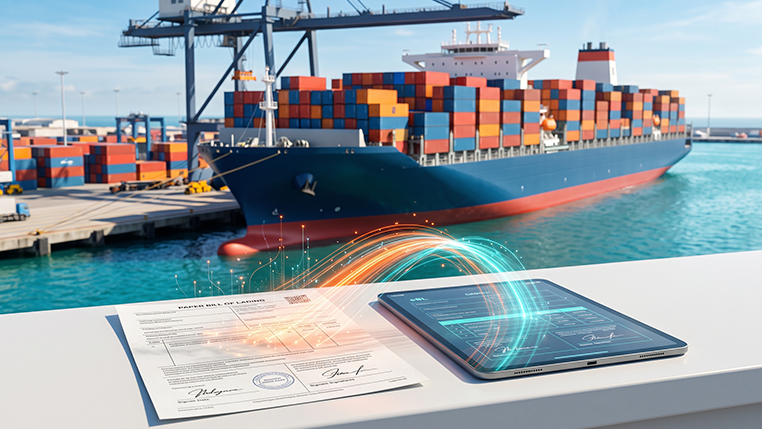
An eBL (electronic bill of lading) is a digital bill of lading that performs all three legal functions of the paper original: receipt of goods, evidence of the contract of carriage, and document of title. The carrier issues it on an approved eBL platform, and the platform makes sure only one party controls the document at any time. That means an eBL can be transferred, pledged to a bank and surrendered for cargo release just like a paper original, but in seconds instead of days.
In 2025, around 11% of container bills of lading were issued electronically, according to DCSA, and the latest DCSA figure, cited by the ICC Digital Standards Initiative, is 12.8%. The major container carriers have committed to 100% by 2030.
Key takeaways
- A sea waybill and a telex release remove the courier step but are not documents of title. An eBL is, so it can be used for letters of credit, to-order shipments and cargo sold in transit.
- Under English law, the Electronic Trade Documents Act 2023 has recognised electronic bills of lading since 20 September 2023. The EU has no harmonised eBL law, and Turkey has not yet adopted MLETR.
- Carriers generally use eBL platforms approved by the International Group of P&I Clubs (IGP&I), because liability from a non-approved system may fall outside P&I cover.
- In June 2026, five eBL platforms adopted the DCSA Standard Annex v.2, creating a multilateral, standards-based network for moving eBLs between platforms.
- For freight forwarders, the shipping instructions (SI) they submit become the eBL, so an error in the SI goes straight onto the document of title.
What does a bill of lading do, and which part is hard to digitalise?
A bill of lading (B/L) has three core functions, and the third one, document of title, is the hard part to digitalise. DCSA describes them as follows (source: DCSA):
- Receipt of goods: proof that the carrier received the described cargo in the stated quantity and apparent condition.
- Evidence of the contract of carriage: the terms on the back of the document define the carrier's obligations.
- Document of title: with a negotiable B/L, whoever lawfully holds the duly endorsed original has the right to dispose of the goods. They can take delivery, sell the goods in transit, or pledge them to a bank.
The first two functions are easy to digitalise. The third is the hard one: title has always been tied to physically holding a piece of paper. The industry needed an electronic solution that could replicate all three functions, including possession, and that is what the eBL does.
eBL vs paper bill of lading: why did paper become a problem?
The paper B/L works, but it is slow, expensive and easy to abuse:
- Couriers are slower than ships on short routes. Originals are often issued in a set of three and couriered from shipper to bank to consignee. On short-sea lanes the cargo often arrives before the documents. Carriers then either hold the cargo or release it against a letter of indemnity (LOI), which shifts risk onto the carrier and its insurer.
- Lost or late originals are costly. A missing original can mean storage and demurrage charges, bank guarantees and delayed payment.
- Paper is easier to forge. Fraud with forged or duplicated originals is a known problem in commodity trades.
- The total cost is large. A 2022 McKinsey analysis, cited by DCSA, estimated that full eBL adoption could save the industry USD 6.5 billion in direct costs and enable USD 30–40 billion in additional annual trade.
The table below compares the paper B/L and the eBL side by side.
How does an electronic bill of lading work?
An eBL is built from two things: the booking and shipping instruction data, and the platform's standard format. Just as with paper, the shipper sends shipping instructions (SI) after booking. Everything on the document comes from that SI: shipper, consignee, notify party, cargo description, container numbers, ports and freight terms. For container carriers, the common data format is DCSA's Bill of Lading standard, currently version 3.0.
The issuer is the same as with a paper B/L: the carrier. The flow looks like this:
- The shipper sends the SI.
- The carrier prepares a draft B/L.
- The shipper checks and approves the draft.
- The carrier issues the eBL on the platform with a digital signature and transfers “control” of it to the shipper.
At that moment the platform creates the document as a single, unique digital record. At any point in time, only one party can control the eBL. The platforms themselves (CargoX, WaveBL and others) do not issue the document. They are the infrastructure where the eBL lives and where its control is tracked and transferred.
Is an eBL the same as a sea waybill or a telex release?
No. A sea waybill and a telex release also remove the courier step, but neither is a document of title, and an eBL is. This is one of the most common points of confusion.
In practice, many shipments that move on a sea waybill or telex release today do not need an eBL at all. The eBL matters where the title function matters: letters of credit, to-order consignments and cargo that changes hands during the voyage.
What is DCSA and what role does it play in the eBL standard?
The Digital Container Shipping Association (DCSA) is a non-profit standards organisation founded in 2019 by major container carriers. Its founding members are MSC, Maersk, CMA CGM, Hapag-Lloyd, ONE, Evergreen, Yang Ming, HMM and ZIM, and PIL joined in April 2024 (source: DCSA).
Like many other shipping standards, the eBL standard is designed, published and updated by DCSA through its eDocumentation initiative. DCSA published the first version of its Bill of Lading standard in December 2020 (The Loadstar). The current version, Bill of Lading 3.0, was finalised in February 2025 (DCSA).
DCSA's interoperability framework has three parts (source: DCSA):
- PINT API: the technical layer for transferring eBLs between platforms.
- Legal framework: a multilateral agreement binding platforms and their users.
- Control Tracking Registry (CTR): a central record of which platform controls each eBL at any moment, so duplicate documents and conflicting claims cannot exist.
This framework was first used in a live shipment that DCSA announced on 15 May 2025. An eBL issued by HMM on CargoX was transferred to the shipper, Suzano, on edoxOnline and accepted there (source: DCSA, SupplyChainBrain). Until then, eBL interoperability existed only as bilateral arrangements between individual platforms. This transaction was the first step towards a multilateral, standards-based network, which took shape in June 2026 when five platforms adopted the DCSA Standard Annex v.2, approved by the International Group of P&I Clubs (IGP&I) (DCSA).
What happens to an eBL after it is issued?
After it is issued, an eBL is transferred, pledged where a letter of credit applies, surrendered for cargo release and finally marked as accomplished. This life cycle is the digital equivalent of the paper endorse-and-courier chain. Every step is recorded on the platform.
Is an electronic bill of lading legally valid in the UK, EU and Turkey?
An eBL is legally valid where national law recognises electronic transferable records, or where every user has signed the eBL platform's legal framework. The reference point is UNCITRAL's Model Law on Electronic Transferable Records (MLETR), adopted in 2017 (UNCITRAL). It gives electronic transferable records the same legal status as paper. As of November 2026:
- Singapore adopted it in 2021 (UNCITRAL).
- The UK took the biggest step with the Electronic Trade Documents Act 2023, in force since 20 September 2023 (legislation.gov.uk). This matters because English law is widely used to govern international trade and shipping contracts.
- Germany has recognised electronic bills of lading in its Commercial Code since 2013 (§ 516 HGB), but the implementing regulation the law provides for has never been issued, and use remains largely contract-based (ITFA).
- The EU has no harmonised eBL law, so recognition depends on each member state's national law (UNCITRAL).
Turkey: Article 1526(2) of the Turkish Commercial Code allows a bill of lading to be signed by electronic means (Kubilay, DergiPark). However, this covers only the signature. It does not regulate the electronic transfer of possession that the document-of-title function requires. Turkey has not adopted MLETR yet. The Ministry of Trade has launched a legal reform project with the EBRD that uses MLETR as its reference.
Where national law is silent, eBL platforms rely on a legal framework or rulebook that every user signs. Some of these rulebooks are governed by English law (IGP&I). For a shipment from Turkey to the EU, check two things: which law governs the platform's rulebook, and whether courts at destination will recognise it. A mismatch here is one of the common pitfalls when moving from paper to eBL.
How do you choose an eBL platform?
The most important criterion is whether the International Group of P&I Clubs (IGP&I) approves the platform. The IGP&I is the association of the 12 mutual insurance clubs that between them cover around 87% of the world's ocean-going tonnage for marine liability (IGP&I). If a carrier releases cargo against an eBL from a non-approved system and something goes wrong, that liability may fall outside P&I cover (IGP&I). This is why carriers generally use approved platforms. The full list is published as IGP&I approved eBL systems.
Beyond IGP&I approval, check:
- DCSA interoperability: can the platform exchange eBLs with other platforms, or does it lock you in?
- Carrier connectivity: does it work with the carriers you actually book with?
- Bank acceptance: will your bank accept it for letter of credit flows?
- API integration: can it connect to your transport management system?
- Pricing: models vary by platform; some use subscription plans, and some carriers offer eBLs to their customers at no extra cost (Hapag-Lloyd).
eBL platforms compared (as of November 2026)
What does the eBL mean for freight forwarders?
The eBL is issued by the carrier, but forwarders sit in the middle of the flow and feel the change first:
- Your SI becomes the eBL. Forwarders usually prepare and submit shipping instructions for their clients. Any error in the SI goes straight onto the eBL, and amending an issued eBL is a controlled process on the platform. Checking the draft carefully matters even more than with paper.
- You need to be on the right platform. To receive or hold an eBL on behalf of a client, you must be onboarded on the platform the carrier uses, or on one interoperable with it. Map which platform each of your main carriers uses before your first eBL shipment.
- Your own house bills can go digital too. Forwarders and NVOCCs (non-vessel operating common carriers) issue house B/Ls. Some IGP&I-approved platforms, such as WaveBL, let forwarders issue electronic house B/Ls, and FIATA's own digital FIATA Bill of Lading (eFBL) has been available since 2022.
How do you move from paper to eBL?
Start with a pilot
Start with pilot shipments on a reliable, repeat trade lane, and run paper and digital in parallel for a while. Update your internal SOPs and train your team. DCSA reports that most cargo owners need outside expertise for the switch (source: GTR). Remember that your consignee and their bank have to accept the system too.
Check your bank and your letter of credit wording
eUCP 2.1 allows eBLs to be presented under letters of credit (L/Cs), but only if the L/C explicitly states that it is subject to eUCP (ICC). In practice, bank adoption is still limited. Confirm that your bank accepts electronic presentation before moving an L/C shipment fully to digital.
Common pitfalls
- The counterparty uses a platform that is not interoperable with yours.
- The L/C does not include the eUCP reference.
- The eBL's governing law does not match the destination jurisdiction.
- The surrender and switch-to-paper procedures are not agreed upfront.
How widely is the eBL used today?
The latest DCSA figure, cited by the ICC Digital Standards Initiative, puts electronic issuance at 12.8% of container bills of lading. On 15 February 2023, the CEOs of all DCSA member carriers committed to issuing 50% of bills of lading electronically within five years and 100% by 2030 (DCSA).
eBL adoption in container trade has grown as follows:
Sources: DCSA, FIT Alliance, GTR, DCSA, DCSA, ICC DSI.
The bulk sector is further ahead. In BIMCO's “25 by 25” campaign, the first four shippers (BHP, Rio Tinto, Vale and Anglo American) reached an average of 25.1% eBL adoption in iron ore trade in the campaign's first year (source: GTR). That bulk is ahead of container makes sense: each bulk supply chain has fewer, more integrated parties.
Among carriers, MSC launched its eBL solution in April 2021, mainly via WaveBL (MSC). Maersk's CEO, Vincent Clerc, has described the paper B/L as one of the most costly and troublesome components of the industry (DCSA). Hapag-Lloyd deliberately runs a multi-vendor strategy and currently offers eBLs through WaveBL, IQAX and Bolero's Galileo platform (Hapag-Lloyd).
What is holding eBL adoption back: technology or behaviour?
Technology is no longer what holds eBL adoption back; the harder problem is that the whole chain has to accept it. There is an ongoing discussion about why the eBL has not been widely adopted yet. Is the barrier technical or behavioural? Here are the questions and my view.
Is the technology not there yet? No. As a software developer, I can say there is basically no technological barrier left. The standards exist, the platforms work, and since May 2025 they even talk to each other.
Is it legal and governance issues? Partly. Legal recognition is moving slowly, and gaps remain in important jurisdictions. But with the UK, Singapore and others on board, it is no longer the main blocker.
Is it behaviour? Yes and no. This is a new way of handling paperwork, and it is normal not to want to be the first mover. But there are also real structural challenges. An eBL only works if the whole chain (shipper, carrier, bank and consignee) accepts it. No single party can push it through alone. That dependency, more than any technology, is what the 2030 target really depends on.
How does Modaltrans fit in?
Modaltrans is logistics software for freight forwarders, customs brokers and logistics service providers working across the UK–EU–Turkey corridor. It is not an eBL platform and does not issue or transfer eBLs; carriers issue them on IGP&I-approved platforms such as those in the comparison table. What Modaltrans handles is the shipment data that goes into them.
In Modaltrans Freight Management, booking, shipping instruction and documentation data live in one shipment record. The parties, cargo description and container numbers that end up on the B/L draft are entered once and can be checked before the SI goes to the carrier. Air freight went through a similar shift with the electronic air waybill, and Modaltrans already supports e-AWBs via Descartes/Traxon.
If you want to see how Modaltrans keeps booking, SI and documentation data in one place across the UK–EU–Turkey corridor, book a demo.