Moving a container from China to the EU involves at least five customs filings: an export declaration in China, an ENS security filing before loading, an arrival notification at the EU port, one or more NCTS T1 transit declarations, and a final import declaration where duties and VAT are paid. Here is how each one works, step by step.
You have a business in Germany. You are importing a container full of electronic equipment from China. In this operation, the products will be transported by ship from the Port of Shanghai to the Port of Rotterdam , and from there to a customs warehouse in the Netherlands. The products will then be transported by road to Germany. So, what customs procedures will be involved in this process, and how will they work?
This raises the following questions:
- What types of declarations are required at which stage of the shipment?
- Which declaration should be submitted to which country along the route?
We will try to answer these questions here.
First, let's briefly look at the concepts of NCTS, ENS, Import Declaration, and Export Declaration. Customs declarations are generally divided into two categories;
- Security Declarations: These are declarations, such as ENS, AMS, and ISF, generally issued before the vehicle arrives at its destination country for risk analysis purposes. They do not involve clearance processes like Duty-VAT. The HMRC ENS system is used for the UK, and the ICS-2 ENS system is used for EU countries for this purpose.
- Customs Declarations: Export and import declarations are necessary for customs clearance, duty-VAT-excise calculations, and the release of goods into free circulation. NCTS declarations are also included in this category as they affect customs procedures.
Briefly, let's talk about the types of declarations;
- NCTS (New Computerized Transit System) is a common transit system used between European Union (EU) and European Free Trade Association (EFTA) countries. NCTS is the electronic system that replaced the old paper-based transit procedures. Where goods once travelled with physical documents such as the TIR Carnet, transit within the EU/EFTA network is now managed entirely digitally. Every transit declaration is backed by a guarantee; if the goods are not presented at the destination customs office, the potential duty and VAT loss is covered by this guarantee. Currently, the UK and Türkiye issue the most transit declarations.
- ENS stands for Entry Summary Declaration. Since 31 December 2010, with the implementation of EU Regulation 1875/2006, the European Union has made it mandatory for all carriers to submit an ENS declaration for cargo arriving at EU ports. All information regarding the cargo, including sender, consignee, and goods details, is transmitted to the EU or UK customs systems. This declaration covers all cargo intended to be loaded onto any ship or vehicle calling at an EU port. ENS declarations are necessary to properly assess the security of cargo.
- An export declaration is a mandatory legal document that informs official authorities of the quantity, value, origin, and buyer and seller information of products sold abroad, and facilitates customs clearance procedures. This document is submitted electronically to customs administrations to ensure the export process is legally completed.
- An import declaration is an official notification document submitted to the customs administration upon the entry of goods purchased from abroad into a country. It contains critical information such as the type, quantity, origin, value, and customs duties of the goods. Without this document, the legal import process cannot be completed. Taxes are calculated during this process, and after payment, the clearance process is completed, and the goods enter free circulation in the relevant country.
Which Declarations Are Needed from China to the EU?
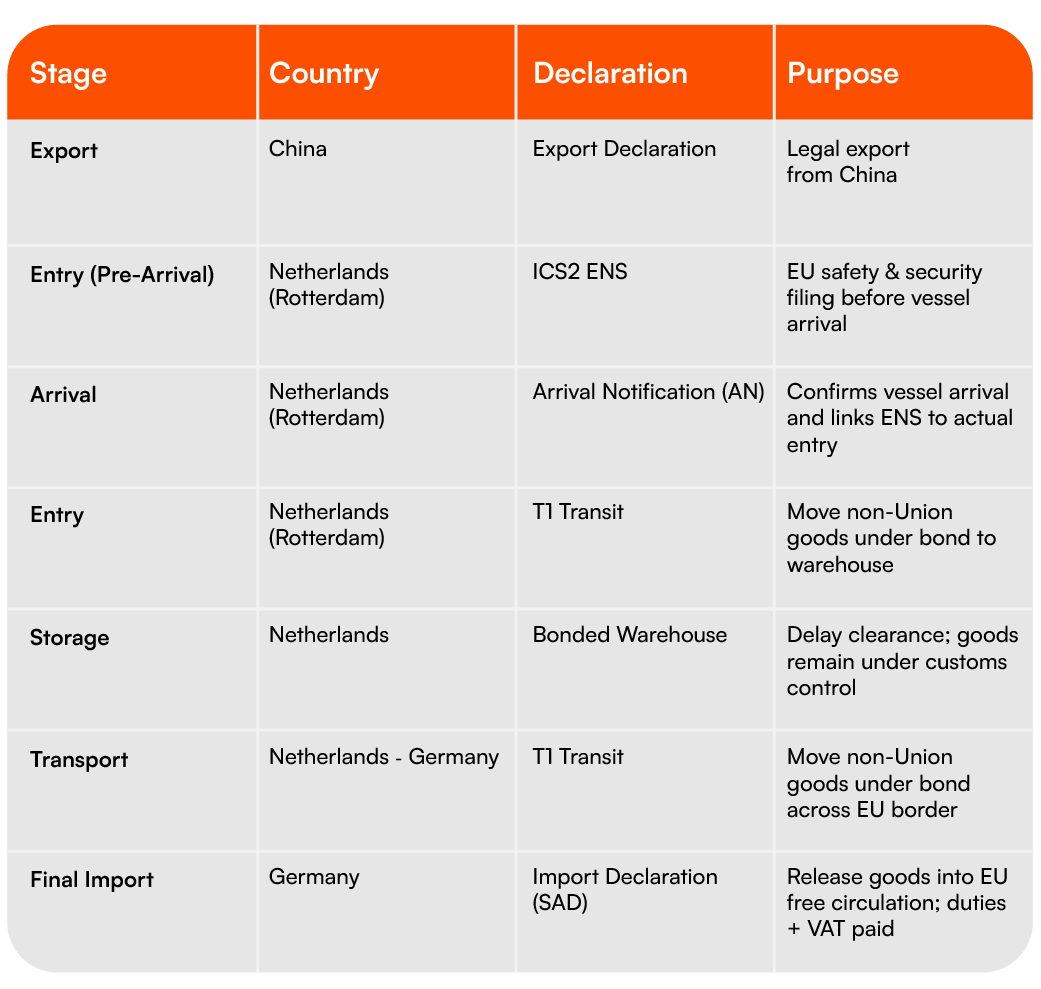
Operation Process: The operation begins in China. No country allows any goods to leave its borders without knowing what's going on. The export of certain products is prohibited or subject to permission. Therefore, there has to be a control mechanism. Here, an export declaration containing information about the sender, consignee, package, and goods is submitted to Chinese customs. Think of the export declaration like the exit stamp on the goods' passport. Without it, the goods cannot leave the country. Stamp obtained — the goods are loaded onto the ship.
The European Union wants to see security information before the cargo even leaves the port, not just when it arrives. After 9/11, the role of customs went beyond simply collecting taxes; a risk analysis is performed for each box in advance. At this point the carrier should send an ENS (Entry Summary Declaration) 24 hours before the cargo is loaded onto the ship. If there is missing information or a risk, a "do not load" instruction will be issued.
The first step upon arrival in Rotterdam is the Arrival Notification, submitted to match the actual container with the ENS record. The goods are still in non-EU status; taxes have not been paid yet. To avoid paying taxes in advance, the importer takes goods to a bonded-warehouse in the Netherlands. For the transport from the port to the warehouse, NCTS is used: this transit entry handles the tax-free, customs-supervised movement of goods through guarantees and electronic tracking. The customs office of departure opens the transit movement and the guarantee is blocked; at the destination office the movement is closed and the guarantee is released. The goods are sealed and digitally tracked throughout the journey.
The most well-known transit declaration opened via NCTS is T1. Roughly speaking, T1 means that the goods are from outside the EU, will enter the EU, the tax has not yet been paid, and they are being transported under surveillance. There is also T2, which covers Union goods moving through common transit countries such as Switzerland. NCTS is not just an intra-EU system. "Common Transit" countries are also included in this system. Following the same logic, it can also work in a network extending from Switzerland to Norway and then to Türkiye.
Even though the container is in a bonded warehouse, it is still considered outside the EU in the eyes of customs; the tax has not been paid. The goods can remain there for months, until they are withdrawn from the warehouse and released into free circulation. To avoid paying the tax all at once, the importer may ship the electronic equipment to Germany in parts. They may even export some of it to Switzerland if they wish; in this case, the EU tax is never incurred.
When the goods leave the bonded warehouse for Germany, they are still considered non-EU. Therefore, again another NCTS T1 entry will be submitted. The trailer is sealed, the guarantee is blocked, and the goods are transported under customs supervision. There are no borders within the EU for goods in free circulation; however, surveillance continues for non-EU goods. The reason is simple: the tax has not been paid yet.
And the final stage. The electronic products have arrived in Germany, and will officially become EU goods. This is where the import declaration is submitted. With this declaration, the goods enter free circulation. Free circulation means that the goods are now treated as if they were produced within the EU. They can be sold, transported, and used as desired. At this stage, import customs duties, VAT, and, if necessary, excise duties are calculated and paid. Thus, the clearance process is completed. These taxes are calculated according to the goods' HS Codes (Harmonized System Code) and origin country. Of course, there can be very complex scenarios.
An import declaration can be thought of as a mirror image of an export declaration. One legalizes the exit of goods from one country, the other their entry into another country. At the beginning, China said "can exit," and in the end, Germany said "can enter." Taxes were paid, and the declaration was closed.
If we summarize all these statements in a table;
Significant tariff changes by the US after 2025 have increased interest in customs procedures. As of July 2026, the EU also introduced a flat €3 tax on small parcels arriving from China. These developments may lead to the perception that customs rules are newly emerging. However, customs is a system that has existed for centuries — the Monumentum Ephesenum (Ephesus Customs Inscription), dating back to 62 AD, details tax rates, checkpoints and exemptions. The monument is preserved in the Ephesus Museum in the Selçuk district of İzmir, Türkiye.
Managing these declarations manually — ENS filings, T1 transits, import entries — is exactly where most delays happen. Modaltrans Customs Management handles NCTS, ENS and import-export declarations from a single platform, across the UK, Türkiye and the EU.